Showing posts with label Rugby. Show all posts

Thursday, 19 January 2017

Tackle laws 2017

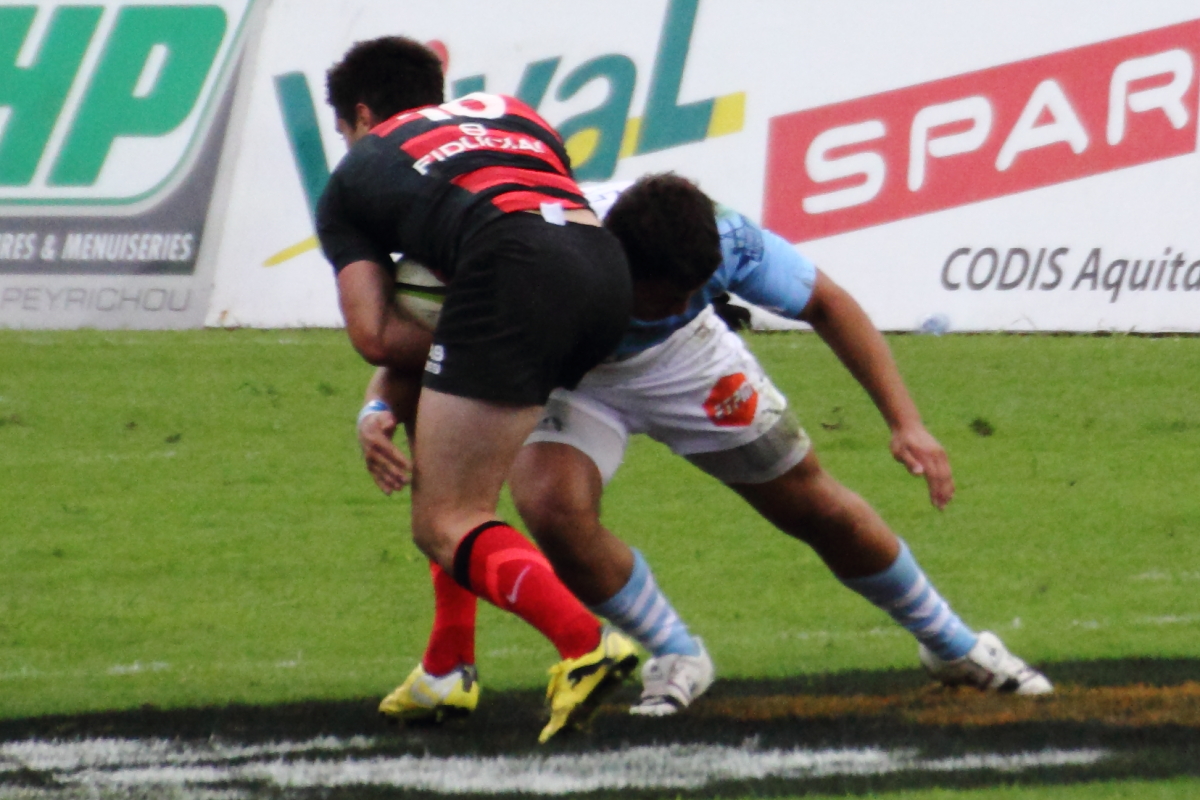
 World Rugby have ramped up the punishment for high tackles, that is tackles above the line of the shoulder.  It’s expected that there will be a spate of red and yellow cards in the next few weeks, making it even more important for players to have the right technique when tackling.
When people think about aiming in rugby, they tend to think about kicking, and maybe passing, but often forget that aiming is also a crucial part of tackling. One of the reasons for high tackles is that the tackler has not aimed at the target area sufficiently accurately.
The target area is usually the thigh, although some might aim for the chest in order to dislodge the ball. But human beings naturally look at another’s face, so the tackler often doesn’t get in position early enough, and may just instinctively stick an arm out, catching the ball carrier in the head.
Whilst averting the eyes to the target, it’s essential to keep the head up. Another mistake made by tacklers is that they drop their head so they’re looking at the ground, misjudge the movements of the ball carrier and end up with concussion themselves due to a knee to the head. As the tackler enters the tackle, they should focus past the ball carrier, and this can help to keep their head up.
As with all aiming, the more accurately you aim the nearer to your target you’re likely to be. At international level, at least, the shorts tend to have an emblem on them which would be at about the right height for the tackler to aim with their shoulder. Otherwise it could be the pockets.
Video is always helpful, so the coach can ensure that tacklers are keeping their heads up, making small steps and continuing to drive through the tackle. The key is to make sure that youngsters have the correct, safe technique from the start, minimising the risks to themselves and to others.


Thursday, 8 October 2015

Rugby World Cup 2015 - Back Row

All rugby players need to be able to tackle, but the back row probably put in more tackles per game than most other players. So it seems reasonable to talk about the visual requirements in tackling for back row players. These would also be largely the same for other players, though the backs might be more likely to find themselves isolated in a one-on-one situation.


Some of the most common mistakes made in tackling include: planting the feet; not getting close enough; not driving in with the shoulder; tackling too high; and getting the head in the wrong position.

The tackler will take responsibility for guarding a channel, so will be looking out for potential ball carriers running into that channel. Once that ball carrier has been identified, the tackler should immediately switch their focus to the ball carrier’s core area (around the stomach), because where the core goes, the player goes. The tackler might also start visualising the tackle.

“Visualise” in this sense means much more than imagining what something will look like: it’s more about imagining the feel of the shoulder making contact with the target area. An early switch of focus to the core means that the tackler will be able to react to a change in direction from the ball carrier, but the initial visualisation might for instance involve the right shoulder driving into the right thigh of the ball carrier level with the bottom of the shorts. This clear preparation should ensure that the head is safely to the side of the ball carrier, “cheek to cheek”. If the tackler drops their head, or gets it on the wrong side, serious injury could result.

We are all naturally drawn to look at other people’s faces, and this is why tackles are often attempted too high. So in training, it’s important that players make sure that they make this early switch in focus and visualisation each time, whilst ensuring that they do not drop their head.

At non-elite levels, you often see players planting their feet quite wide apart, sometimes stretching their arms out to the side, supposedly making themselves a more difficult target to avoid. But it’s very difficult to get any power into the tackle from that position, and it’s also very difficult to react to any late movement from the ball carrier. The tackler often ends up having to dive to make a tackle. This is likely to be ineffective if high, and runs the risk of their head getting in the way of a stray boot if the tackle is low. The tackler is also vulnerable to the hand off if the ball carrier runs straight at them because they are in such a weak position.

The tackler should aim to get their feet in close to the ball carrier, so it’s essential to keep their feet “active” with small steps. One tip is to imagine a hula hoop around the ball carrier, and if the tackler is aiming with their right shoulder, they should try and get their right foot within that hoop. Another tip when training is to get the tackler to keep their hands in to their chest, and to push against a ball carrier without extending their arms, which again ensures they’ve got in close.


As the ball carrier gets in range, the tackler dips the shoulder (dipping the shoulder too early can expose the head), but it’s still essential to keep the head up. So the eyes focus on the target before contact, and then past the ball carrier when contact is made. The feet must keep moving with small steps to drive through the tackle as the arms close around the ball carrier. If the tackle is made from the side, the ball carrier’s own momentum should cause them to fall over with the tackler on top.

David Donner

Wednesday, 30 September 2015

Rugby World Cup 2015 - Props

It is essential for their own safety that props have the correct body alignment before the scrum engages. They can check, for instance, that their back is straight by crouching alongside a mirror, at home or in the gym. They can do this with their eyes closed, and then look in the mirror to see if the correct position has been achieved, and the forces from the players behind will be transferred forward in a straight line.


It can be really helpful to video one versus one scrums, so you can check that they have maintained the correct position on engagement. The players can view it themselves so they can confirm that there sensation of body position matches the reality.

The position of the head and neck are vital as it’s very easy to get into an unnatural position, and serious injury could result. Once the player is in the crouched position, you can get him to stand up straight, but making sure that his head and neck position are unchanged. Do they remain in a natural position? If the neck is unnaturally forward or back it is in an unsafe position.

One suggestion for finding the correct head position is to wear a pair of sunglasses. In the crouched position, you lift your head up until you can just see over the top of them. You check this as before by standing up and seeing if it still in a natural position. 

One technique that can be really useful for props to get maximum power in the scrum is centring. This is a visualisation technique that involves putting the focus on the centre of your body. This makes the player more balanced, and therefore increases power, especially as the focus is on the area where there are larger, more powerful groups of muscles.

Getting into the correct body position is also very important in lifting at the lineout. A common fault is to allow the head to fall forward, so that the arms cannot lift straight up but at an angle, with the resulting loss of power and direction. Lifters also need to make sure that they keep forwards to their fellow lifter. If they look up, they are almost certain to tip back a bit and lose the ideal strong position for maximum lift.

David Donner

Thursday, 10 September 2015

Rugby World Cup 2015 - Hookers

In honour of the rugby World Cup, I thought I’d do a short series on the visual requirements for some of the different positions starting with the hooker.

When people talk of visual requirements, they usually refer to the visual requirements of the player - things like having good visual acuity and peripheral vision. I tend to approach it another way, by looking at the visual requirements of the sport itself.

For a hooker, one of the main requirements is to be able to throw a ball into a lineout in such a way that it can be caught by the intended player on your side, and not intercepted by the opponents. Of course, it’s not always the hooker’s fault when this doesn’t happen, as it’s very much a team effort between thrower, lifters and catcher, and also depends on the ability of the opposition to defend.


One of the main difficulties for hookers is that they don’t actually have a target to aim for. They’re aiming for a space above the catchers head. But if it’s a throw towards the back of the line out, they often have to throw the ball in a parabola to evade the opposition’s catcher in the middle. If that’s someone like Devin Toner, who’s nearly seven feet tall before he’s lifted, that’s not an easy task.

You can get hookers to practise their throwing by aiming at a mark on a post, and that would certainly be better than nothing. But the best way to practise getting the correct trajectory for deeper throws would be to throw the ball through a hoop. The hoop would be set at the height of the opposition’s front jumpers.

I’ve seen this done with a tyre suspended from the cross bar. But ideally you’d want this to be hoop on an adjustable stand, and you’d want a second one set for the height of your tail catcher. The hooker then practises getting the ball through both hoops. This can be done as an individual practice, just with one set of forwards, and as fully contested lineouts.

The hooker should also spend some time throwing whilst blindfolded, giving the brain a chance to concentrate on the kinaesthetic (muscle) feedback with each throw. The position of the hands holding the ball, especially the little finger, must be identical each time (see earlier blogs).

The visual requirements of hooking the ball are minimal, certainly at elite level, because there’s hardly any hooking these days. Put-ins are still as straight as a dog’s hind leg, so it’s more important to push than to hook the ball. I read that Sean Fitzpatrick used to practice with his eyes closed, so he could still hook the ball even if he couldn’t see it because he was pushed out of position by the opposition scrum. Unless or until referees insist on the put-in being straight, I can’t see many people practising that today.

David Donner

Tuesday, 30 June 2015

Mind The Gap

A new batsman comes to the wicket. He surveys the field, making a careful note of the fielders’ positions. After blocking a few deliveries, he starts to play some more expansive shots, and hits them, unerringly, straight to the fielders.

From a ruck, the ball is passed to the first receiver who runs forward a couple of steps before being driven back in the tackle by two defenders.

A succession of crosses and corners fail to beat the first defender. When the winger does finally manage to locate his centre forward, the latter isn’t able to generate enough power in his header to trouble the goalkeeper.

What’s going on? The answer is that each player is telling his subconscious brain to pay attention to the position of the opposing players (or his own player in the last example). The brain is then told what skill to execute. The task is then carried out using those visual cues as targets.

Even if you told your brain something like “Don’t hit the ball to the fielder”, the subconscious brain, which doesn’t understand spoken language very well, just hears “hit – ball – fielder”.


The answer, if you’re a coach, is not to tell your players to look for where the fielders/defenders are, but to look for where the gaps are. So a new batsman would survey the field looking for those gaps, and maybe start visualising hitting the ball into those gaps. In net practice, you can put markers on the net to indicate fielding positions. But if the batsman doesn’t seem good at avoiding them, you might want to highlight the gaps between them using coloured markers.

You might also want to remind your players that cricket, rugby and football pitches are pretty large compared to the size of even adults. If they were a bird flying over the ground they would see lots of gaps. So in cricket, if there are few gaps in a ring of close fielders, they need to think about how they could safely hit the ball over them into those gaps. Imagining they were high above the ground looking down might help them.


In sports such as football and rugby, the task for coaches is to get their players to think of themselves as “space invaders”.

David Donner

Friday, 22 May 2015

Why Passes in Rugby Go Astray

Why do so many passes in rugby go astray? Even at higher levels of the game, many promising moves break down because the receiver has had to reach up, or even reach behind him (or her), to take the ball.


Sometimes, there will be technical reasons, such as passing off the wrong foot. Often, the pass from 9 to 10 will go high because the 9 has been imbalanced at the point of ball release. This can particularly happen if the front foot has come too far across. In an effort to maintain balance, the head comes back and up, with the result that the pass has an upwards trajectory.

But the main reason that passes go astray is that they have not been aimed properly, and this generally happens because rugby players are human beings. If one person is looking to see where another person is, it is natural to look for their face, just like you would look for somebody’s face in a photograph. But if you are looking at the receiver’s face when you pass the ball, it’s likely that the ball will go in the general direction of their face. If the receiver is running forwards, the ball may well disappear somewhere behind their head.

The other problem is that receivers like to read the intentions of the players inside them. In particular, they might want to see if the ball carrier is looking in their direction, so they can anticipate when the ball might be coming in their direction. In order to get a good view of the face, they come up almost level with the ball carrier. This means that the ball carrier has only three options, all of which are poor: a forward pass; a flat pass that the receiver can’t run onto; or a pass behind the receiver.

The answer is to train players, ideally from a young age, to use their vision effectively. How many coaches drum into their players that passes should be made for the receiver and not to the receiver? How many explain where the ball should be aimed, and how this varies according to the speed of the receiver? How many tell the receivers about being able to see the number on the back of the ball carrier’s shirt so they don’t overrun the ball?

Above all, are coaches using realistic opposed drills, so the players can put all this in the context of the timing of the pass, and whether to pass or not? If you are, then asking the right questions, even with young players, can lead to the players working out the answers for themselves. For instance, what are they looking for in the defenders that tells the whether to pass or dummy? What can they do in their footwork that would make them more effective?


But if players are taught in a mechanistic way, then you might as well just pick bigger and bigger wrecking balls, and not bother about the fact that they can’t pass a ball. Some would say, we’ve reached that point already.

David Donner

Monday, 27 April 2015

Sports Vision Casebook - Rugby Place Kicking

There are two main visual components of place kicking in rugby: alignment and visualisation.

There’s not going to be one correct method for alignment or visualisation for everyone, so there’s likely to be a certain amount of trial and error, for instance in choosing the type of kicking tee that suits you best.


The first part of alignment is to align the tee, and then the ball on the tee. Leigh Halfpenny aligns the tee with the centre of the posts and the seam of the ball with the right hand post, taking into account the natural draw for a right-footed kicker. Similarly, Jonny Wilkinson tilts the ball a little to the left, and Dan Carter at the start of his run up, aims for the left hand post.

As you move forward to kick the ball, the focus should be on the precise point of the ball where you want to make contact .This means picking a spot within the pattern of the ball, as small as a dimple, and keeping a constant fixation on that spot.

Some players have a tendency to lift their head as they kick, to watch the path of the ball. Lifting the head too early will result in a loss of power and control. If this is a persistent problem, you can try keeping a tennis ball under your chin to keep your head down.

When Johnny Wilkinson was taking kicks for England, he’d imagine that there was a lady called Doris whom he could see through the posts sitting in the crowd. I think at one time he imagined she was reading a newspaper. Then he imagined she was holding a drink which he would try and knock out of her hand. He would then have an imaginary line, like an imaginary wire, the ball would follow on its way through the posts to Doris.

Leigh Halfpenny visualises a third post in the middle of the other two. He aims to hit that middle post. If it’s a windy day, he moves that imaginary post slightly to compensate. He imagines that the sweet spot of the ball is attached by a piece of string to that third post. He looks back from the post down the piece of string.

A combination of these ideas might be very effective: for instance, you might imagine a real or fictional character sitting on top of the imaginary third post and pulling the string. Your aim would be to knock that character off their perch.

Visualisation can also be effective in dealing with the pressure of taking the kick. Halfpenny, for instance, always imagines his old training ground of Gorseinon, even when he’s in the Millennium Stadium.

Then it’s just a question of practice, and more practice. If you practice the more difficult kicks, it will make most of the match day kicks seem easier. Halfpenny even takes kicks form the try line to hit the post as a test of his accuracy.

David Donner